


- This event has passed.
Webinar on Material Modeling and Simulation for Academic Research
June 17 @ 10:30 am - 11:30 am
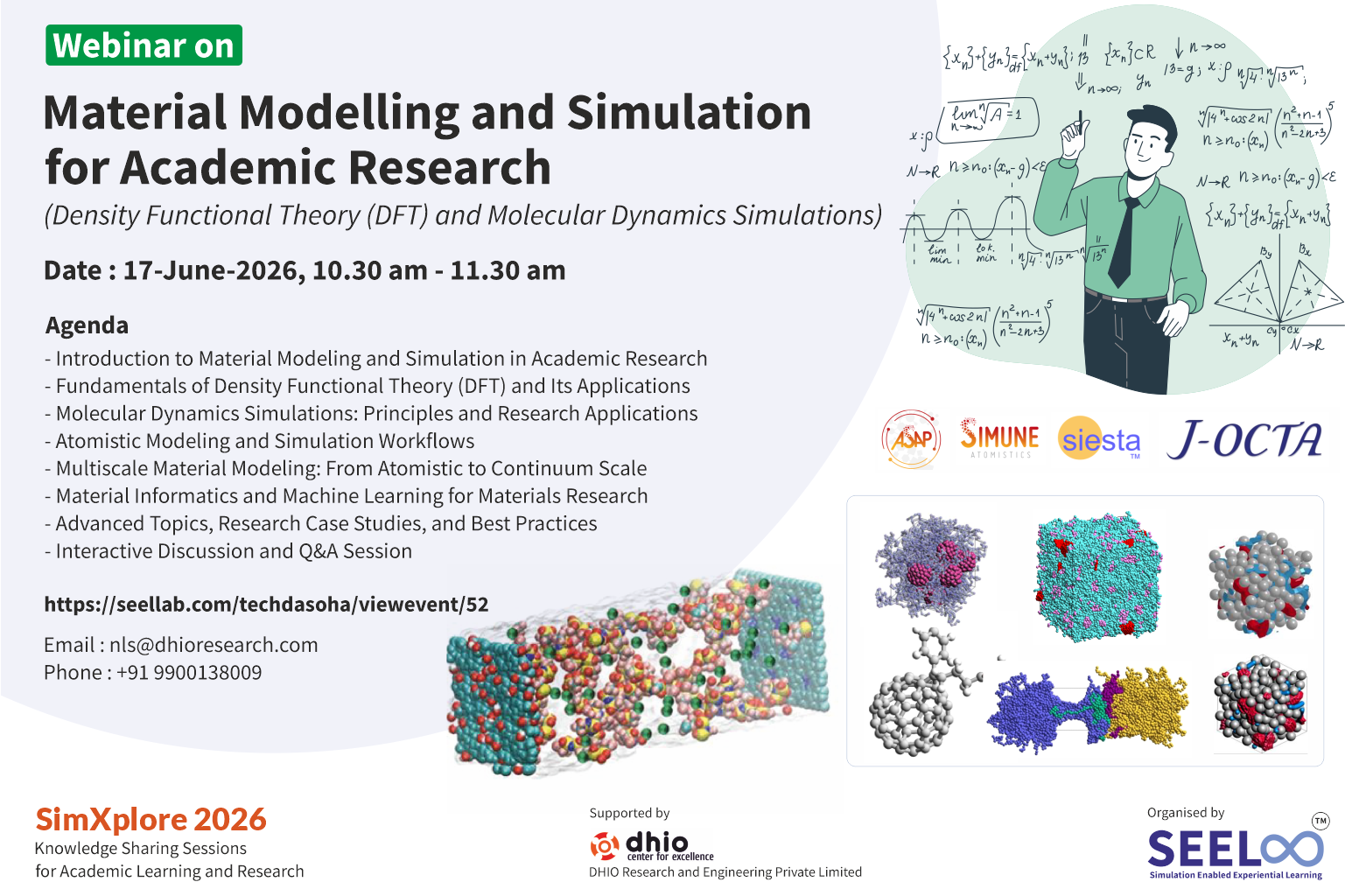
Density Functional Theory (DFT) and Molecular Dynamics Simulations)
About the Webinar
Material Modeling and Simulation have become indispensable tools in modern scientific research, enabling researchers to understand, predict, and optimize material behavior across multiple length and time scales. From the electronic structure of materials to atomistic interactions and macroscopic performance, simulation-driven research is accelerating innovation in materials science, physics, chemistry, energy storage, semiconductors, aerospace, and advanced manufacturing.
This webinar provides an introduction to state-of-the-art computational techniques, including Density Functional Theory (DFT), Molecular Dynamics (MD), and Multiscale Modeling approaches. Participants will gain insights into how these methods are applied in academic research to investigate material properties, predict performance, reduce experimental costs, and accelerate scientific discovery.
The session will also explore emerging trends in Material Informatics and Machine Learning, highlighting how data-driven methodologies are transforming materials research and development.
Whether you are a faculty member, research scholar, postgraduate student, or industry researcher, this webinar will provide valuable insights into modern computational materials engineering workflows and real-world research applications.
Key Topics
- Introduction to Material Modeling and Simulation
- Fundamentals of Density Functional Theory (DFT)
- Molecular Dynamics Simulations and Applications
- Atomistic Modeling Techniques
- Multiscale Material Modeling: From Atomistic to Continuum Scale
- Material Informatics and Machine Learning for Materials Research
- Advanced Research Applications and Case Studies
- Interactive Q&A Session
Who Should Attend?
- Faculty Members and Researchers
- Ph.D. Scholars and Postgraduate Students
- Materials Scientists and Engineers
- Mechanical, Chemical, Aerospace, and Electronics Engineers
- Computational Modeling and Simulation Professionals
- R&D Personnel from Industry and Research Organizations
Learning Outcomes
By the end of the webinar, participants will be able to:
- Understand the role of computational modeling in materials research.
- Differentiate between DFT, Molecular Dynamics, and Multiscale Modeling approaches.
- Identify suitable simulation methodologies for various research problems.
- Explore opportunities for integrating Machine Learning with materials modeling.
- Gain exposure to practical research case studies and industrial applications.
Date: 17-June-2026
Time:10.30 am – 11.30 am
Join us to explore how advanced material modeling and simulation technologies are shaping the future of scientific research and engineering innovation.