


- This event has passed.
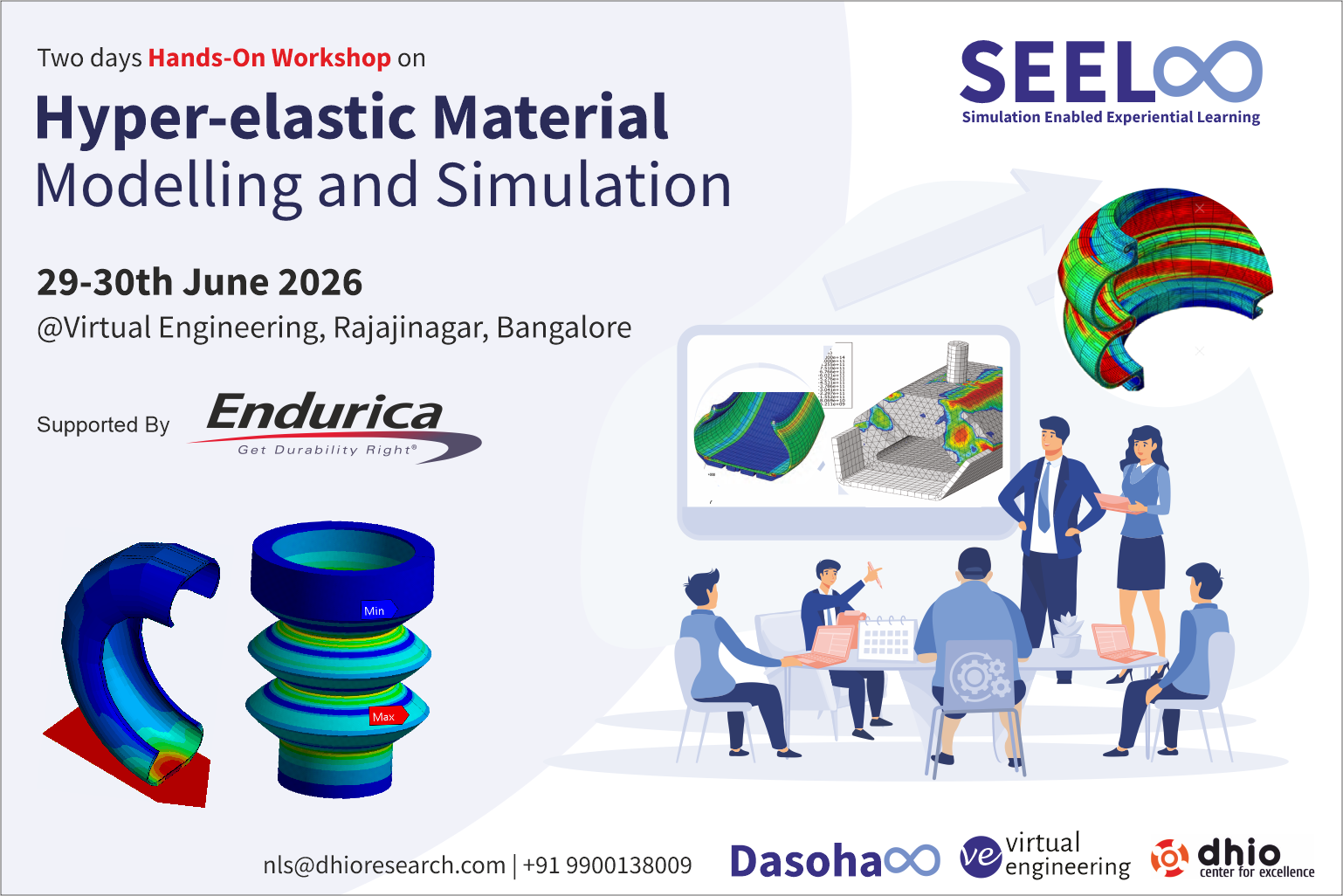
Two days hands-on-workshop on Hyperelastic Material Modelling and Simulation
June 29 @ 9:30 am - June 30 @ 5:30 pm
About Workshop
For many ideally elastic materials, linear elastic models as per the Hook’s law do not accurately describe the observed
material behaviour. Most common example of such kind of material is rubber, whose consecutive relationship are defined
by nonlinear elastic, isotropic, incompressible, independent of strain rate. Hyper-Elasticity is the study of material behaviour which do not obeys the Hook’s law and behaves nonlinearly within elastic limit and provides constitutive relation between the stress-strain from strain energy density function. Thus, hyper-elastic idealization models are widely adopted in the industrial products which are manufactured using elastomers. The course is composed of both theory and practical’s using commercial software.
This Workshop reviews issues commonly faced when pursuing fatigue performance in elastomeric products, and the
problems that can be solved using modern characterization and analysis techniques. It introduces technologies, solutions
and workflows that you can use to achieve your durability targets for problems involving nonlinear material behavior, and
multiaxial, variable amplitude loading. The training includes a case study demonstrating the application of Endurica CL and Endurica DT for fatigue analysis
Topics Covered (Theory & Practical)
- Mechanical Behaviour of Elastomers: General Material Behaviour, Elasticity and Plasticity Mathematical material Model, Incremental plasticity theory, Yield criterion, Flow rule, Hardening Rule, Kinematic hardening,
Isotropic Hardening, Viscoelastic behaviour, Elastomer behaviour under Loading-unloading condition, Creep and Relaxation. - Hyper-Elastic Material Model: Ronald Rivlin and Melvin Mooney models, Neo-Hookean and Mooney–Rivlin model, Ogden model and the Arruda–Boyce model.
- Introduction to Finite Element Method: Finite Element Formulation for linear Analysis, Nonlinear Analysis, Modelling Issues: Element Selection, Meshing Considerations, Constraints and Reinforcements, Contact, etc
- Testing Methods for Hyper-elastic material: Tensile, Compressive,Bending and Fatigue testing methodology.
Numerical Problems: Involving Hyper-elastic behaviour. - Numerical Problems: Involving Hyper-elastic behaviour.
- Fatigue and Fracture: Introduction to fatigue, Mechanism of Fatigue, Endurance curve, Factors Effecting Fatigue, Fatigue Life Prediction Approaches. Rate laws for both cycle & time dependent crack growth, including threshold effects and ozone attack. Overview of Fracture Mechanics, Crack precursor growth tracking based on Fracture Mechanics, Rainflow Counting on history of the critical plane, Common modes of failure, Energy release rate, Stress Intensity Factors, Fracture Mechanics Approach to Fatigue Design.
- Rubber Durability Simulation : Calculating Fatigue life and Failure location on the part, Critical Plane Analysis to check every potential crack orientation, Damage Extrapolation for residual life, Self-heating analysis, Co-simulation for Ageing and Cyclic Softening, Fatigue Life prediction of parts subjected to lengthy multi-channel Road Load
Signals (RLD).
https://www.seellab.com/techdasoha/viewevent/50
Contact Details
Ms. Poshitha
poshitha@dhioresearch.com
Phone : +91 70194 48044
Mrs. Nethra Santhosh
Email :nethra@virtual-engineering.com
Phone : +91 9900103378, 9591994642
Virtual Experiential Learning Pvt Ltd
28, 36th Cross, Rajaji nagar 2nd Block
Bangalore – 560010
Www.virtual-engineering.com